

Global Plan for the Decade of Action for Road Safety 2021-2030
This Global Plan has been developed by the World Health Organization and the United Nations Regional Commissions, in cooperation with partners in the United Nations Road Safety Collaboration and other stakeholders, as a guiding document to support the implementation of the Decade of Action for Road Safety 2021–2030 and its objectives.
IRTAD Road Safety Annual Report (2025)
The Road Safety Annual Report 2025 provides an overview of road safety performance for the 40 countries participating in the International Transport Forum’s permanent Working Group on road safety, known as the IRTAD Group. Based on the latest data, the report describes recent road safety developments in these countries and compares their performance against the main road safety indicators.
PIARC Road Safety Manual - Fourth Edition (2025)
The fourth edition of PIARC RSM is designed to help countries at every stage of infrastructure development to fulfill road safety objectives. It includes new thinking on road safety and offers a clear argument on why adopting a Safe System approach is crucial for your country.
Safer Micromobility: Technical Background Report (2024)
In 2020, the ITF published “Safe Micromobility”, a report assessing the safety of micromobility and new mobility services. In the four years since publication, much has changed in terms of the evidence base regarding the safety of micromobility. This report summarises an analysis of the current evidence base of the most recent micromobility safety trends and risks.
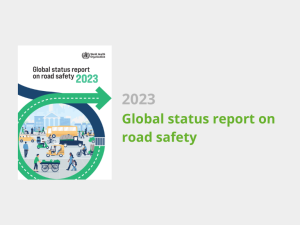
Global status report on road safety (2023)
The WHO’s “Global status report on road safety 2023″ shows that the number of annual road traffic deaths has fallen slightly to 1.19 million. The report shows that efforts to improve road safety are having an impact, and that significant reductions in road traffic deaths can be made if proven measures are applied.
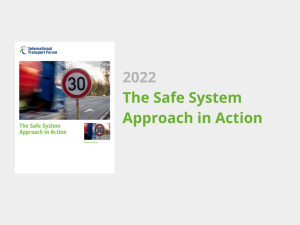
The Safe System Approach in Action (2022)
This report provides experience-based guidance on implementing the Safe System approach. The report also presents lessons from 17 case studies of road-safety interventions with a Safe System component. The case studies reveal no single recipe for successful implementation. Instead, they point to a variety of approaches conditioned by national and local contexts, and the crucial role of robust institutional governance and co-operation between partners.
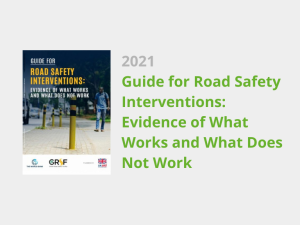
Guide for Road Safety Interventions: Evidence of What Works and What Does Not Work (2021)
This World Bank guide provides evidence-based guidance on road safety interventions within the Safe System approach. It examines measures across road safety management, infrastructure, speed, vehicles, road users and post-crash care, highlighting interventions that have demonstrated effectiveness in reducing fatal and serious injuries and those for which evidence of safety benefits is limited.

Monitoring Progress in Urban Road Safety (2020)
This ITF/OECD-report tracks the progress in reducing the number of road traffic fatalities and serious injuries in cities since 2010. It presents traffic safety data collected in 48 cities. It compares urban with national road safety trends and provides road safety indicators for different road user groups.

UNRSC Towards the 12 Voluntary Global Targets for Road Safety (2020)
This document, prepared by several members of the United Nations Road Safety Collaboration (UNRSC), acts as a guide to assist countries to monitor and report on the 12 Voluntary Global Road Safety Performance Targets, which was published by the WHO in 2017.

Sustainable Development Goals (2015)
The 2030 Agenda for Sustainable Development, adopted by all United Nations Member States in 2015, provides a shared blueprint for peace and prosperity for people and the planet, now and into the future. At its heart are the 17 Sustainable Development Goals (SDGs), which are an urgent call for action by all countries – developed and developing – in a global partnership. SDG3 and SDG11 both have targets related to safe (road) transport.

Towards Zero Ambitious Road Safety Targets and the Safe System Approach (2015)
The report reviews the state of the art in improving road safety performance and examines the role of targets in raising the level of ambition and achieving effective implementation of road safety policies. It highlights the institutional management changes required in many countries to implement effective interventions and underlines the economic case for road safety investment.
Road Safety Management Capacity Review Guidelines (2013)
The Road Safety Management Capacity Reviews and Safe System Projects Guidelines have been designed to assist country road safety professionals, World Bank and regional development bank staff, international consultants, community groups, private sector organizations, and all other global, regional and country partners and stakeholders to conduct capacity reviews and prepare follow-up road safety projects in a variety of low and middle-income countries and investment settings.

Implementing the Recommendations of the World Report on Road Traffic Injury Prevention (2009)
Following the WHO’s World report on road traffic injury prevention from 2004, this report provides guidelines for countries for conducting Road Safety Management Capacity Reviews and the specifications of Lead Agency reforms, investment strategies and safe system projects. As such the report provides a pragmatic approach designed to overcome institutional capacity barriers and achieve sustainable results.

World report on road traffic injury prevention
In 2004, worldwide, an estimated 1.2 million people were killed in road crashes each year and as many as 50 million were injured. Projections indicate that these figures will increase by about 65% over the next 20 years unless there is new commitment to prevention. This joint WHO and World Bank report underscores their concern that unsafe road traffic systems are seriously harming global public health and development. It contends that the level of road traffic injury is unacceptable and that it is largely avoidable.