
For specific themes or issues, as its own initiative or on demand, FERSI can install a dedicated working group. The output can be a scientific paper or report with the latest knowledge on a specific issue, a position paper on new developments and related research gaps, or an advise on current policy issue or research needs. Previous FERSI working groups dealt with a variety of topics including vulnerable road users, vehicle automation, serious injuries, road safety economics, road safety management, and safety performance indicators.
FERSI publications
FERSI column: Road safety management in municipalities cannot progress without data and modern technologies
In a new column, FERSI member Marta Petrova, Chairperson of the Bulgarian State Agency Road Safety (SARS), explores how digital technologies, GIS-based road inventories, and risk assessment models can help municipalities move towards proactive, data-driven road safety management. Drawing on the Bulgarian experience, she highlights key lessons and policy recommendations for improving infrastructure safety assessments and prioritising investments, even when public resources are limited.
FERSI column: Safe Automated Driving Needs Smarter Roads — Not Just Smarter Cars
In a new column, FERSI member Markus Deublein from the Swiss Council for Accident Prevention (BFU) argues that safe automated driving cannot be achieved by smarter vehicles alone. Drawing on a wide body of European research on connected and automated mobility, he identifies eight key priorities for infrastructure, from managing the risks of the mixed-traffic transition phase to building robust digital safety layers and ensuring cross-border interoperability.
FERSI column: Forgiving roadsides – the perspective from car and two-wheeler road users
In a new column, FERSI member João Cardoso from the Portuguese Laboratório Nacional de Engenharia Civil (LNEC) focuses on the importance of roadside safety. Supported by European and national crash data, he points at the urgent need for good and updated roadside safety criteria and their implementation – not only on motorways and other major roads, but also on secondary rural roads. And not only for car users, but certainly also for two-wheelers.

FERSI column: Automated vehicles’ safety and the human perspective
This new FERSI column, written by Evangelia (Lila) Gaitanidou (CERTH/HIT, Greece), emphasizes that, in the end, upon achieving an adequate level of technology, the success of automated vehicles in improving safety highly fully relies on the users, their acceptance of and trust in the system. The column calls for explicit consideration of the human perspective in the further development and deployment of automated vehicles.
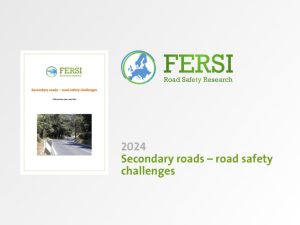
Secondary roads – road safety challenges
This FERSI position paper demonstrates the important contribution of secondary rural roads to the burden of road traffic injuries and fatalities. It identifies the most important road safety challenges and emphasizes the corresponding need for addressing these by introducing appropriate remedial road infrastructure measures and new technologies, supported by consistent research and innovation. The report is also available in Portuguese.

Column: To the core of road crash causes
In a new column, FERSI colleagues Jindřich Frič & Pavel Havránek from the Transport Research Centre, Czech Republic, point at the need of in-depth crash analyses including analyses of the involved vehicles and their damage as well as some recent Czech research projects in this area.

FERSI Column: Road Safety - Identifying the innovations that provide the best crash injury protection for all
In the new FERSI column Professor Astrid Linder (VTI) sets out the need to provide all car occupants with the best crash injury protection and not just the ‘50th percentile male’. Ideally, car safety assessments should account for sex, body height, weight, and age to ensure occupant protection for all.

FERSI column: What is the level of cyclist safety in the Danube Region?
FERSI column by Marko Ševrović & Anđelo Marunica (University of Zagreb, Faculty of Transport and Traffic Sciences). The column presents some results of the SABRINA project, expressing concern about the safety level of the cycling infrastructure in the Danube region.

Essential European road safety research lacking
In a position paper, FERSI expresses its concern that European road safety research is no longer delivering what it ought to, impeding the improvements needed to achieve the European ambitious road safety targets. The paper details how the structure of road safety research funding in Europe impacts the potential progress that can be made in European road safety ánd provides some suggestions for solutions.

Column: Is e-scooter sharing declining?
This 3rd column is written by Luca Persia, Director of the Research Centre for Transport and Logistics (CTL) of Sapienza University of Rome. It reflects on the rise and the current downsizing of e-scooters, and their pros and cons for urban mobility.